
Episode #186 – The Anti-Demon
Episode #186 | Published March 23, 2026
This episode builds a physical theory of Bitcoin from first principles. It starts with a clay jug, works through Rolf Landauer’s 1961 IBM paper on the thermodynamics of computation, and arrives at a proposed equation: K=IC². The claim is that Bitcoin operates as the structural inverse of Maxwell’s Demon. Ten years after The Bitcoin Standard, most people still aren’t paying attention.
Episode Summary
The Bitcoin Standard has been out for a decade and the accumulation window has been open since 2009. Nobody is spontaneously wising up. Max pain until you want to give up isn’t a phase the market passes through on its way to something easier; it’s the permanent weather for anyone holding a position the crowd hasn’t reached.
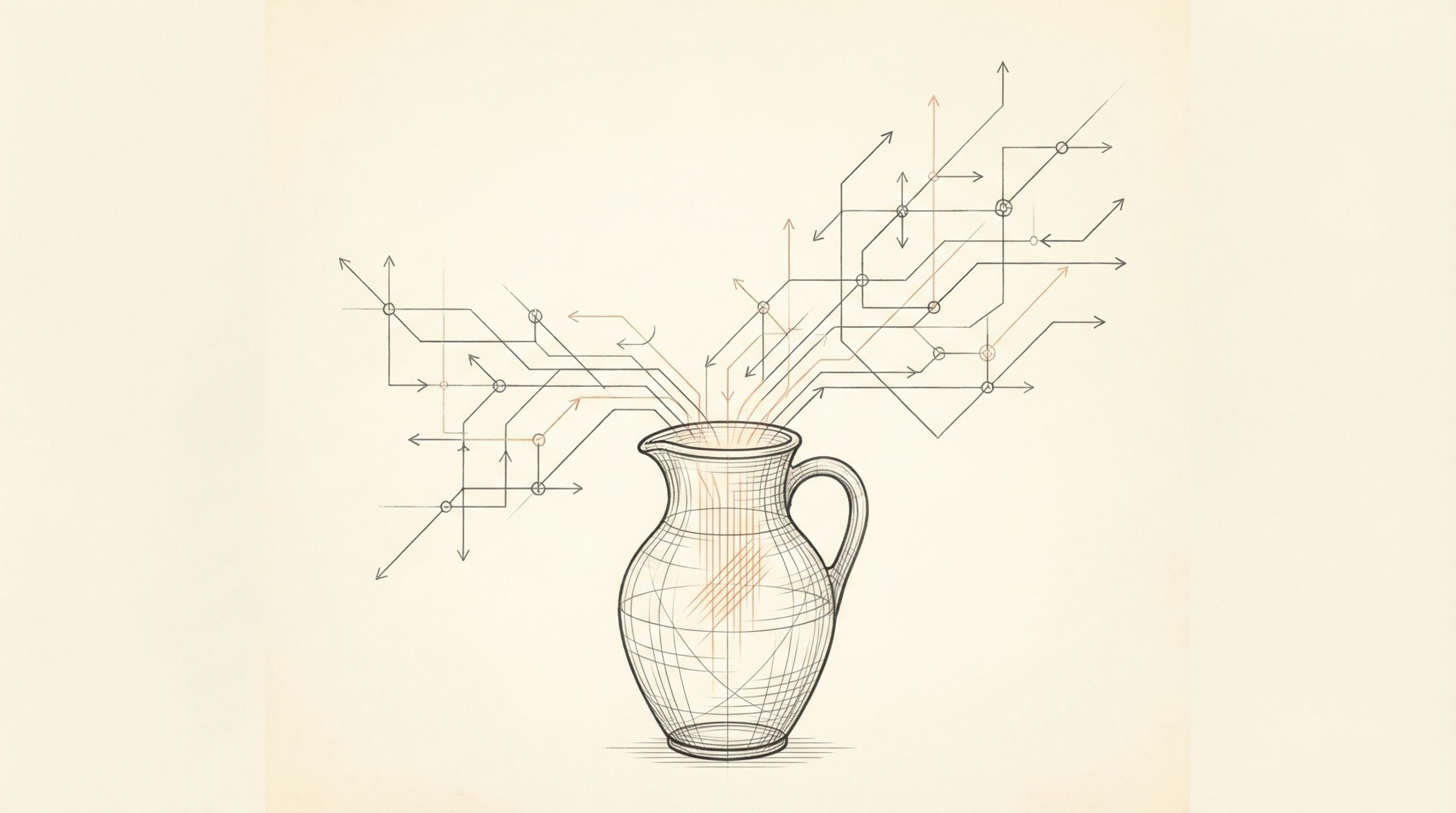
The argument begins with a clay jug, which turns out to be a more interesting object than it sounds. A lump of clay and a finished jug share the same atoms and the same mass, but the jug has one thing the lump doesn’t: a boundary that separates inside from outside. That boundary, a physical constraint imposed by the potter, creates interior space where none existed before. The lump can’t hold water. The jug can. And once you can hold water you can irrigate, and once you irrigate you get agriculture, fermentation, wine, trade routes, entire civilisational arcs the potter never imagined. None of that was planned. The potter imposed a boundary, and the physics took over from there.
Rolf Landauer at IBM showed in 1961 that erasing one bit of information costs a minimum amount of energy dissipated as heat, about 3 × 10⁻²¹ joules per bit at room temperature. The number is absurdly small, but the implication behind it rewires how you think about information: information is physical. Every bit is a specific arrangement of matter, not some abstract layer floating on top of the hardware. The arrangement is the information. Bit erasure has been confirmed experimentally, which means the abstraction and the thermodynamics are the same object.
Before 2009, a distributed ledger where altering any record required repeating real thermodynamic work was valid in principle but couldn’t hold its shape, like a column of water with no vessel. Proof of work is the vessel. Miners burn energy through trillions of failed SHA-256 hashes, and the valid block header left standing is a thermodynamic receipt you can’t forge without repeating the work. Every ten minutes the constraint tightens another notch.
Maxwell proposed his thought experiment in 1867: a tiny being stationed at a partition between two gas chambers, sorting fast molecules to one side and slow ones to the other, creating a temperature difference without any apparent energy input. For nearly a century the paradox stood open, because nobody could identify where the thermodynamic cost was hiding. Landauer found it. The demon has to erase its memory to keep sorting, and that erasure, however minimal, costs energy. Second law intact.
Bitcoin runs this logic in reverse. Maxwell’s demon accumulates knowledge cheaply and defers the thermodynamic bill to the moment of erasure; Bitcoin pays the bill first, burning through trillions of failed hashes before a valid block even exists. The demon’s sorting is temporary because once its memory clears the system slides back toward equilibrium. Bitcoin’s ledger persists, and every new block makes the previous ones more expensive to revise. One system defers cost and produces temporary order. The other front-loads cost and produces a permanent record.
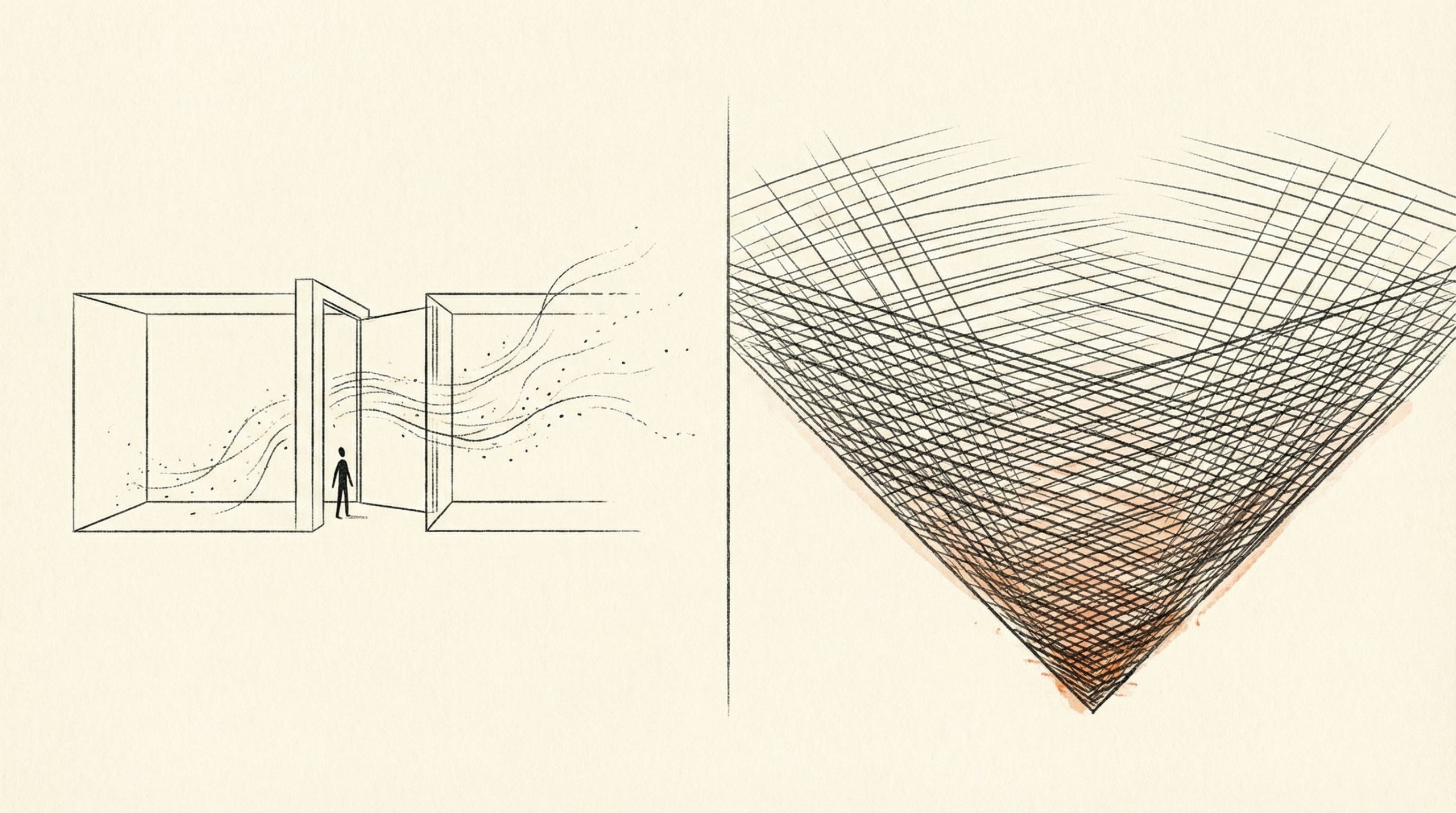
The proposed formula is K=IC². Knowledge equals information times constraint quality squared. Bitcoin’s information is transaction data. Its constraint is proof of work. The knowledge it produces is the unforgeable ledger you get when you combine the two. Bitcoin currently operates at roughly 10²° above the Landauer minimum for equivalent information processing, which is a staggering overpayment by any engineering standard. But that overpayment is doing the work; it’s what makes the ledger durable enough to trust across decades and jurisdictions. You can’t have both cheap and unforgeable.
Physical systems tend toward equilibrium. Stars burn out, chemical reactions settle, black holes evaporate given enough time. But there is no known physical process that runs knowledge backwards. Fire stays invented. Each block added to the Bitcoin chain raises the thermodynamic cost of rewriting what’s behind it, and there’s no identified ceiling on how far that process extends. The jug metaphor lands here: constraint doesn’t limit what’s possible inside the vessel. Constraint is what makes the interior exist at all, and each expansion of the interior opens room for the next one.
Timestamps
- [00:00] Opening: the reality check on Bitcoin accumulation and max pain
- [03:00] The gravity well: capturing energy before the window closes
- [05:30] Michael Saylor and the fee-seeking fund manager problem
- [08:00] The clay jug: how a constraint creates new interior space
- [13:00] Landauer’s Principle: information is physical (Rolf Landauer, IBM, 1961)
- [17:00] Bitcoin as physical technology: proof of work as thermodynamic boundary
- [21:00] Maxwell’s Demon: the century-old paradox and how Landauer resolved it
- [24:00] The Anti-Demon: Bitcoin inverts the cost structure
- [27:00] K = IC²: knowledge equals information times constraint quality squared
- [30:00] The knowledge ratchet: why Bitcoin made the framework thinkable
- [33:00] Cosmological significance: knowledge creation as an open-ended physical process
Timestamps are estimates.
Topics Discussed
- Ten years of The Bitcoin Standard and why public understanding hasn’t budged
- The clay jug as a thought experiment in how physical constraint creates interior space and emergent complexity
- Landauer’s Principle (1961) and the thermodynamic cost of erasing one bit
- Information is physical, confirmed experimentally
- The Bitcoin ledger as a thermodynamic structure, not a database
- SHA-256 failures as the work that makes the receipt valid
- Maxwell’s Demon: the 1867 thought experiment and why it took 94 years to resolve
- How Bitcoin inverts the Demon’s cost structure
- K=IC² introduced
- Operating 10²° above the Landauer minimum
- Why overpaying for constraint is the product
- Knowledge as a one-way ratchet
Links & References
- Information Processing and Thermodynamic Entropy (Stanford Encyclopedia of Philosophy)
- Maxwell’s Demon (Encyclopaedia Britannica)
- Rolf Landauer, “Irreversibility and Heat Generation in the Computing Process” (1961)
- David Deutsch, The Beginning of Infinity (2011)
- Satoshi Nakamoto whitepaper
Related Episodes
- Episode #182 – Kabuki Theatre – theater versus physical reality in financial systems.
- Episode #183 – Capital in the 22nd Century – wealth as knowledge and why model assumptions matter.
- Episode #184 – On the Same Page – K=IC2, quantized time, and constraint quality.
Notable Pull Quotes
“The information is the hardware, in a particular arrangement.”
“Proof-of-work is the digital jug.”
“The overpayment is the security. The overpayment is the constraint quality.”
“The jug enables wine, which enables trade, which enables civilization, which enables science, which enables computation, which enables Bitcoin, which enables the framework that explains why jugs matter.”
Post a comment: