
Episode #194 – States that Travel
Being early and being wrong are the same position, and the original Bitcoin thesis, the one that expected people to figure it out quickly, was 90 percent wrong. Out of that error comes a working definition of value, and underneath it a definition of knowledge: arrangements that keep their shape as they travel between physical substrates and across time. The compensation for a world too busy to notice is the closing line: nobody knows yet, and that means you’re safe.
Episode Summary
The original thesis, the one Michael Saylor still narrates in interviews, held that people would figure Bitcoin out quickly, that everyone would see their future selves better off and scoop it up, and that the only rational response was to spend every waking moment accumulating before the crowd arrived. The crowd never arrived on schedule. Being that early is the same thing as being wrong, and the honest accounting puts the error at 90 percent. What the error left behind is its own compensation: having been slightly wrong for years means having been slightly right for years, a position from which Bitcoin has kept increasing wealth through every drawdown, five of them now, each absorbed with the same practiced indifference. The fluctuations stopped mattering once the knowledge did its work.
That indifference recently produced a discovery, posted to Nostr a couple of months back: a loophole, shorting MSTR, that behaves like a machine into which other people volunteer their fiat dollars and out of which comes Bitcoin. A good business with a stated horizon, because in a Bitcoin-denominated world with no fiat left to arbitrage, value has to be produced rather than intercepted. That admission sets the real subject, the one the last several episodes have been circling: a working theory of knowledge, and with it a working theory of what value actually is.
Start with wealth, a definition worth testing on people who have never thought about money at all: wealth is the total sum of transformations one can bring about in the world. The pursuit behind it is persistence, more future transformations at one’s own disposal, and the engine of persistence is knowledge, information with causal power. Knowledge comes in three kinds. Structural knowledge is the order the laws of physics assemble on their own, planets and stars, matter drawn together by gravity. Reflective knowledge is life, DNA its classic case. Explanatory knowledge is what human beings generate, and it is on its way to overtaking structure as the dominant constraining force in the physical universe. Fiat fails this whole test because it ships with an edit button, and wherever an edit button exists and individuals control it, they press it, since pressing it is the path of least resistance. When falsifying a record is cheap, preserving it becomes impossible.
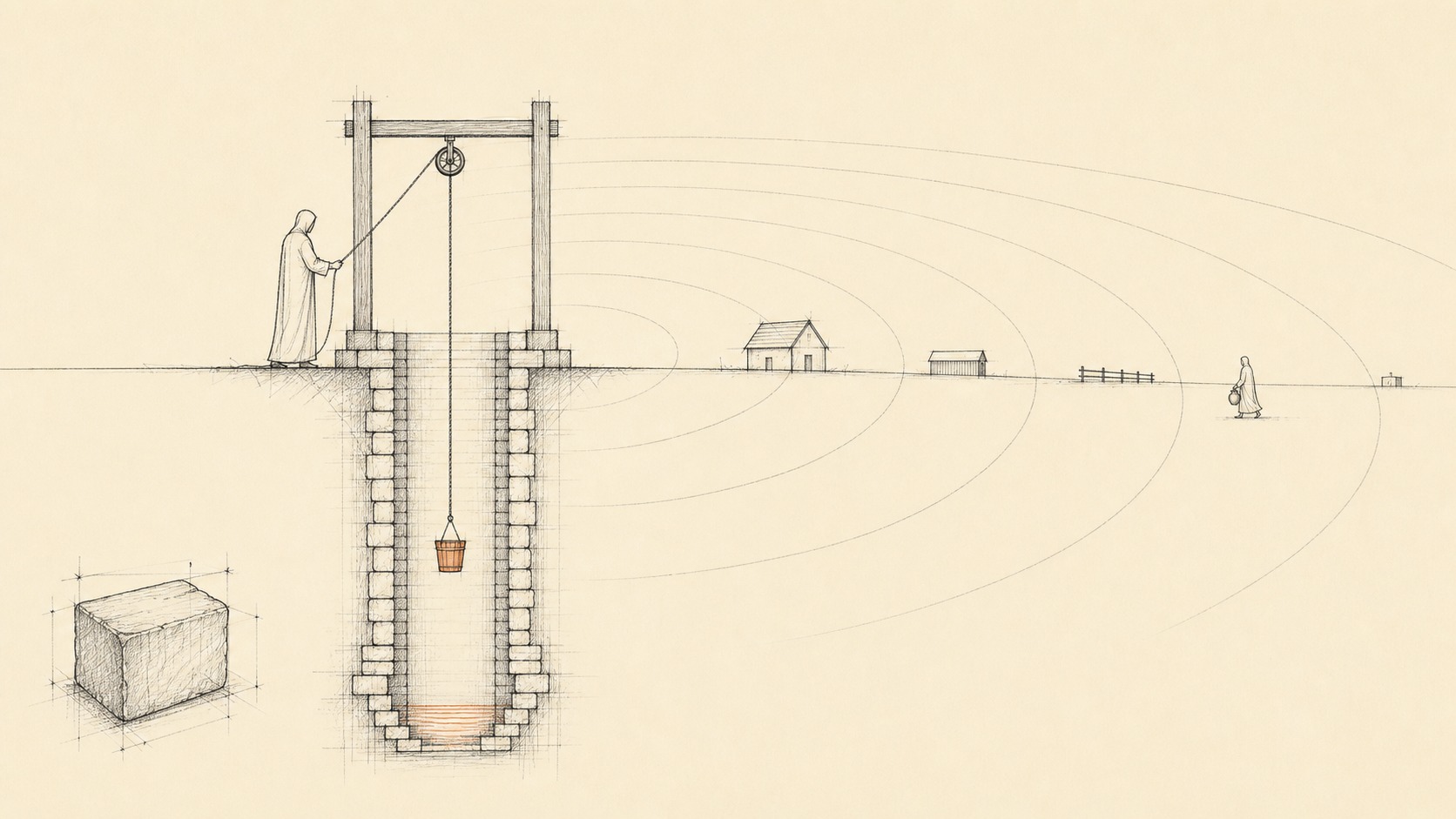
Value, then, is constraining matter so that other knowledge generators have more possibilities open to them, more accessible phase space. The jug from earlier episodes returns: the potter takes clay the customer could never have constrained alone, because the skill stacks on a pyramid of prior figuring-out, and hands over the finished constraint. The well makes the same point at town scale. A settler in a dry western town finds the water, digs the hole, lines it with stone so it cannot collapse or foul, and sells access to a future that now contains water. The catch is that constrained matter cannot be copied; the next town needs its own well, dug at full energy cost. Software escaped that limit, constraining matter once and copying the arrangement everywhere, which explains most of the wealth it created, but it had to defend its scarcity with walls of logic. Bitcoin’s one solved problem was replacing walls of logic with walls of work: scarcity defended by physics rather than by rules.
Hence the shape of the service. Most people will never take the explanation on board, and offering it stopped being worth the effort years ago; testing these arguments on strangers ended because nobody cared, and people will come when they feel the pain. What they want is a solution: their life is hard, they don’t know why, and somebody is willing to stand between them and the machinery grinding them down. Taking their fiat, converting it, and refusing to flinch at down 50 percent is constraining matter and opening phase space for people who could not have opened it themselves. Perhaps one in a hundred watches the well-digger long enough to notice the trick is stone plus energy, and goes off to dig their own; the rest keep paying a dollar for the bucket, and stay glad of the deal. Even the resulting pile is defensible: holding without spending is deferral, the charitable act of generating accessible phase space for the extended order and declining to ask any of it back.
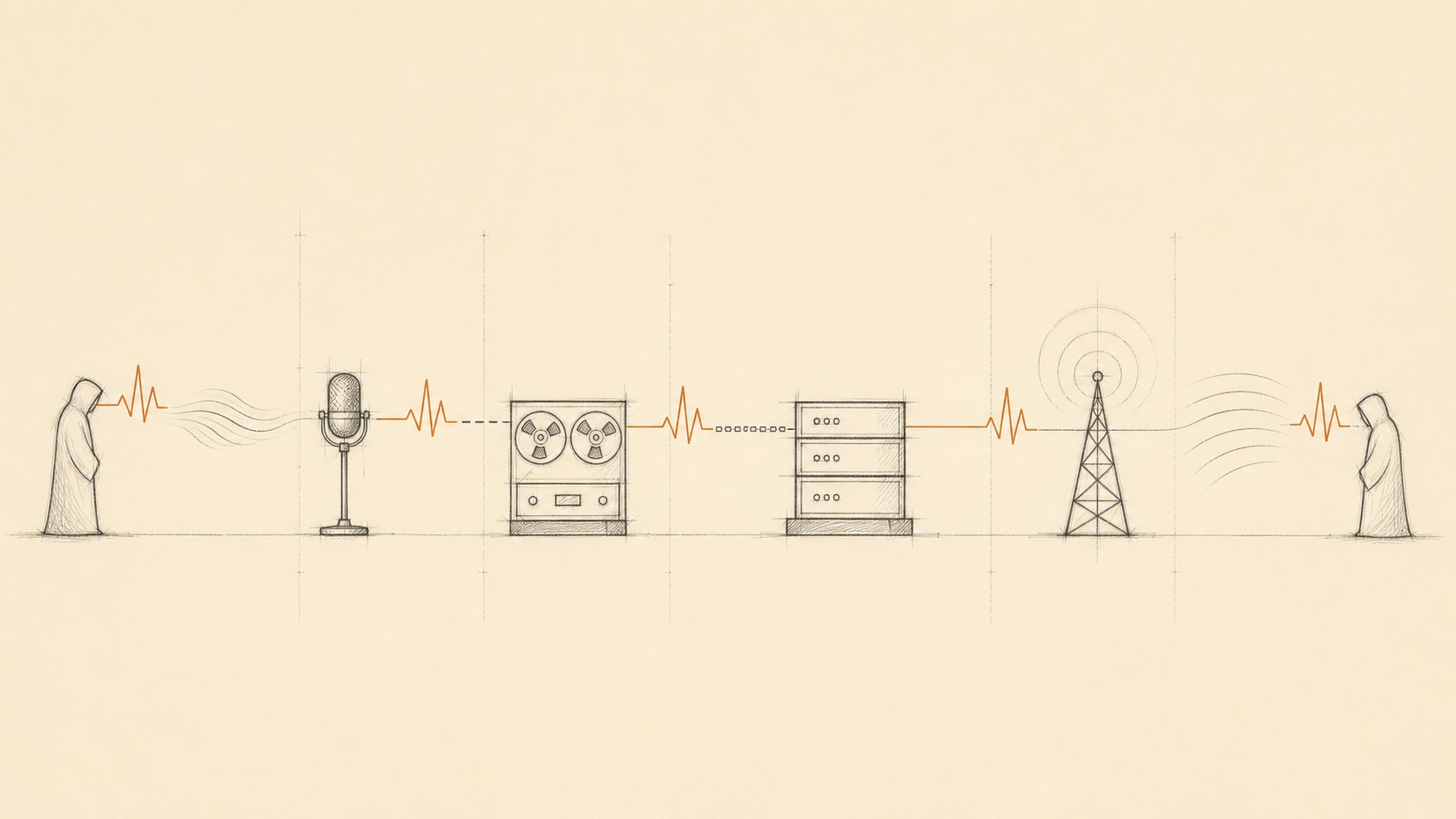
Knowledge, in the definition that gives this episode its title, is arrangements that travel, and travel means what it says. An arrangement of neurons produces a signal; the signal drives vocal cords; shaped air crosses the room to a microphone; the microphone hands a pattern to a recorder, which commits it to ones and zeros, compresses it, ships it to a server, and eventually reconstitutes it in a listener’s ear. One arrangement, seven substrates, shape preserved at every hop. Whether it persists in depth, across time and state transitions, depends on whether it is useful, whether the people who take it on board find their wealth increased and build on top of it. How far it spreads in breadth over the information manifold is its reach. Storage has become nearly free and lossless, so depth is cheap now; reach is the contested dimension, and the question for any arrangement is whether more people holding it would open more accessible phase space in the universe. For this one, at least locally, the answer is yes.
The larger project behind all of this is K = Ic², and the discovery underneath it is that computation is physical. There is no ethereal realm where ideas live; every idea is instantiated in some substrate, which means every idea is bound by the laws of physics, which means ideas are affected by gravity. Gravity has been the universe’s chief constrainer of matter since the beginning. One thing escapes it: explanatory knowledge, which is mobile, and jumps to substrates that gravity holds less tightly. It follows that the thing worth maximizing, for an individual and for the extended order alike, is knowledge generation, and the recipe has been known since the Enlightenment: conjecture and criticism, as many bites at the apple as possible, the loop of intelligence fired as many times as it will fire. A large language model generates information at enormous speed, but nothing inside it clicks over into an irreversible future state; the person choosing remains the pawl. The same test picks where to live. A place open to knowledge generators has no central planner arranging information, nothing locked in place that cannot be changed, and looks, from any distance, like freedom maximization.
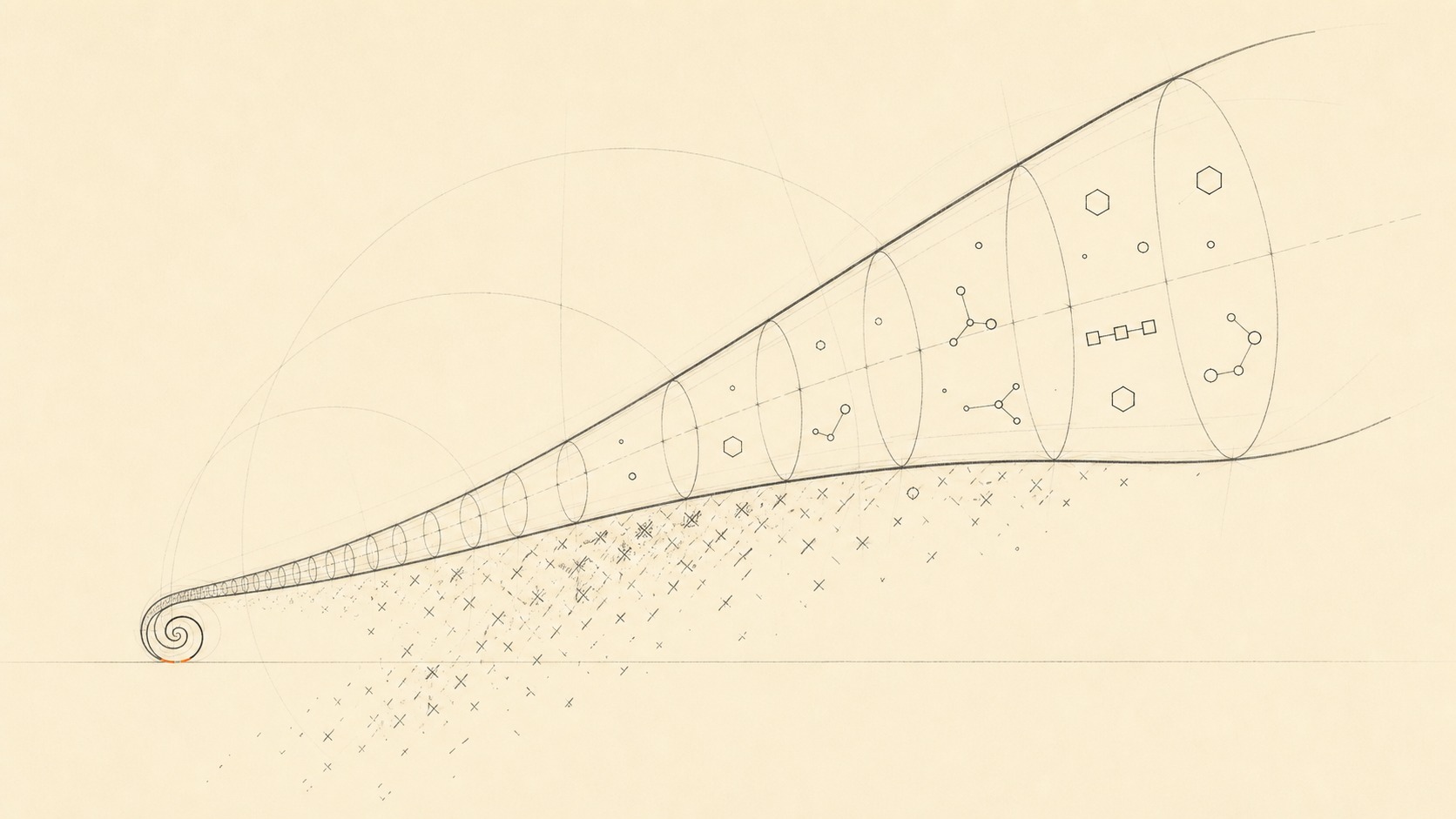
None of this forecasts imminent recognition. Sentiment inside Bitcoin has rarely been worse, miners are bidding against AI datacentres for energy, and the public conversation has moved on to abundance, as though money were about to be retired altogether. But the abundant future already arrived: show your life to someone from the 1800s and ask whether money is gone, then notice that it matters more than ever, and that abundance means more arrangements to choose between, which makes the chooser more important rather than less. Adoption stays slow because most people are consumed by nearer problems, and the CLARITY Act and MSTR matter mainly as plumbing that lets trapped capital reach Bitcoin at last. Nor does the process run out of road: entropy is the exhaust of order generation, so the universe never reaches maximum constraint and the horn never pinches off. Which leaves the listener with the good part. Nobody knows yet. You’re safe.
Timestamps
00:00 – Opening: the original thesis and the 90 percent error
00:50 – So wrong so early, which is the same as being wrong
01:12 – The loophole: a machine that turns volunteered fiat into Bitcoin
01:56 – In a Bitcoin-denominated world, value has to be produced
02:16 – The larger problem: a working theory of knowledge
03:23 – Structural, reflective, and explanatory knowledge
04:37 – Wrong about the number of state transitions
05:56 – Value as constraining matter; the jug and the pawl
07:36 – The cost of falsifiability versus the cost of preservation
07:52 – The most valuable service available: being the constraint
09:54 – The well: dig once, line it with stone, sell the phase space
11:31 – Walls of logic replaced by walls of work
13:53 – Holding as deferring: the charitable act
14:53 – Bitcoin as a model of the universe viewed from outside
17:40 – A definition of wealth to test on strangers
18:20 – The worst sentiment in memory, and why it doesn’t matter
18:49 – The abundant future is already here
20:01 – You are the pawl in the loop with the LLM
20:48 – Knowledge as arrangements that travel
21:14 – One arrangement crossing seven substrates
22:47 – Depth, breadth, and reach over the information manifold
24:50 – K = Ic² and the discovery that computation is physical
25:30 – Ideas are affected by gravity; one thing escapes
26:37 – Maximizing knowledge generation: conjecture and criticism
28:13 – Where to live: freedom maximization
30:03 – Entropy as the exhaust of order generation
30:43 – The CLARITY Act, MSTR, and trapped capital
32:41 – Nobody knows. You’re safe.
Timestamps are approximate.
Topics Discussed
- The 90 percent error: overestimating how fast people would figure Bitcoin out, and why early and wrong are the same position
- A machine for turning volunteered fiat into Bitcoin, and its honest limit in a Bitcoin-denominated world
- Wealth defined as the total sum of transformations one can bring about in the world
- Structural, reflective, and explanatory knowledge, and which one is taking over as the universe’s dominant constraint
- Value as constraining matter to open accessible phase space for others
- The well and the jug: why constrained matter resists copying, and why software’s copyability produced so much wealth
- Walls of logic versus walls of work, the one problem Bitcoin solved
- The charitable act: holding as deferral rather than hoarding
- Knowledge as arrangements that travel: substrates, depth, and reach
- Computation is physical, so ideas are affected by gravity, and explanatory knowledge is the one thing that escapes
- Conjecture, criticism, and why an LLM without a pawl generates information rather than knowledge
- Freedom maximization as the filter for where to live
- Entropy as the exhaust of order generation, and why the horn never pinches off
- The CLARITY Act, MSTR, and capital that couldn’t reach Bitcoin before
Links & References
- Satoshi Nakamoto, “Bitcoin: A Peer-to-Peer Electronic Cash System” (2008)
- David Deutsch, The Beginning of Infinity (Allen Lane, 2011) on explanatory knowledge, and conjecture and criticism
- Karl Popper, Conjectures and Refutations: The Growth of Scientific Knowledge (Routledge, 1963)
- F. A. Hayek, The Fatal Conceit: The Errors of Socialism (University of Chicago Press, 1988) on the extended order
- Rolf Landauer, “Information is Physical” (Physics Today, vol. 44, 1991)
- Jeff Booth, The Price of Tomorrow (Stanley Press, 2020) on why you don’t know how badly you’re getting hosed
- H.R. 3633, Digital Asset Market Clarity Act of 2025 (congress.gov)
Related Episodes
- Episode #193 – The Locus of Intelligence covers the loop of intelligence this episode wants fired as many times as possible, and the LLM with no pawl.
- Episode #190 – Time covers state transitions, persistence, and time as accumulated commitment.
- Episode #189 – Gabriel’s Horn: The Shape of Everything covers the horn this episode says never pinches off.
Notable Pull Quotes
“I was so wrong so early, which is the same thing as being wrong.”
“Wealth is the total sum of transformations that one can bring about in the world.”
“You are the pawl. You’re the click that doesn’t go backwards.”
“The one thing that can escape gravity is explanatory knowledge.”
“Nobody knows. You’re safe.”
Post a comment: