
Episode #189 – Gabriel’s Horn: The Shape of Everything
Episode #189 | Published April 23, 2026
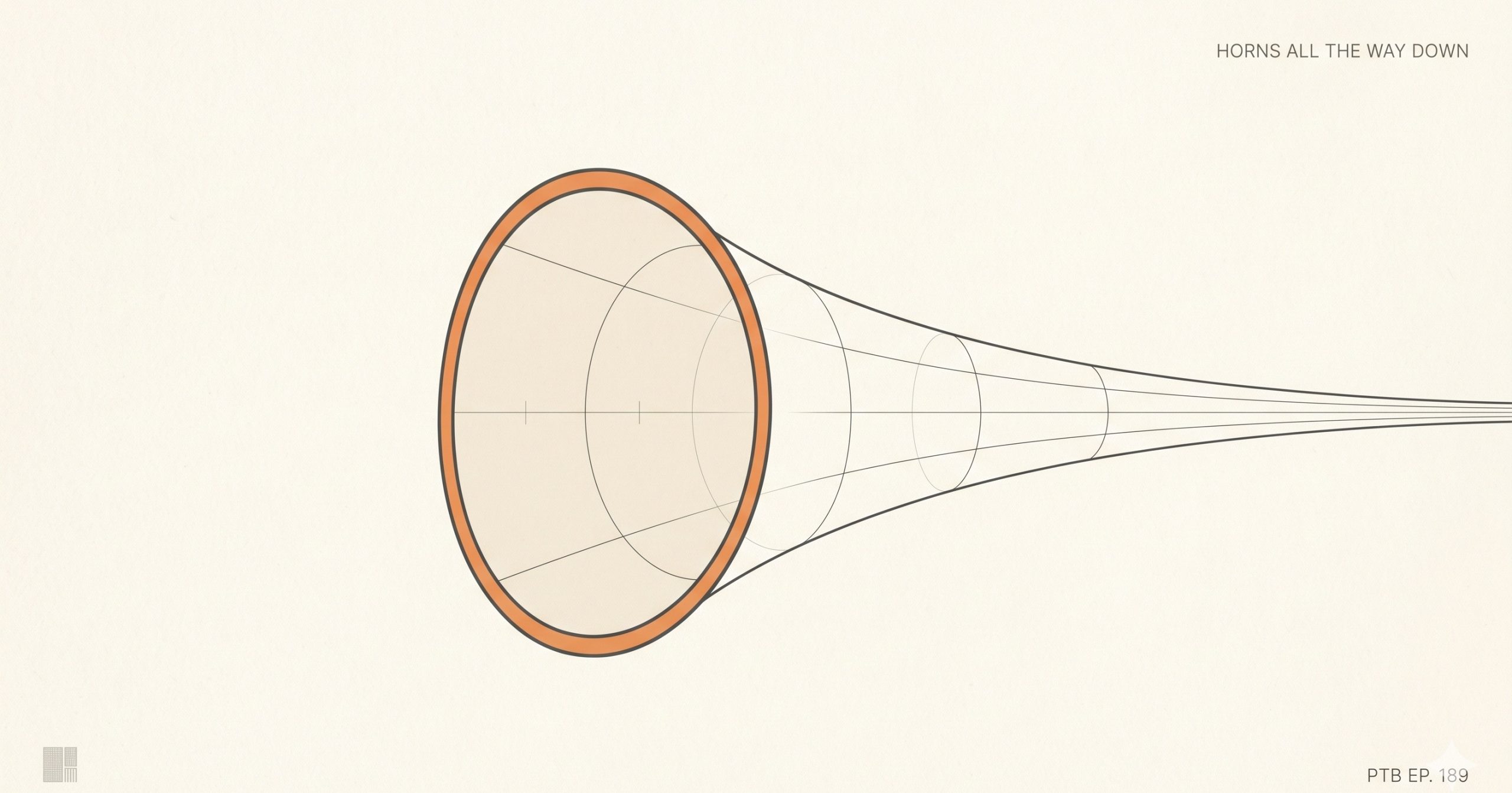
In 1641, Evangelista Torricelli rotated the curve y = 1/x around the horizontal axis and obtained a shape whose interior volume converges to π while its surface area diverges to infinity. Mathematicians of the day called it an abomination. Three centuries later, Jacob Bekenstein proved that the entropy of a black hole scales with its event horizon, not its volume. This episode argues that Gabriel’s Horn is the universal blueprint for every structure that creates, stores, or processes knowledge, and that no horn stands alone.
Episode Summary
Torricelli used the proto-calculus of indivisibles available in 1641 to measure his trumpet and got two numbers that should not have coexisted. The interior volume came out to π exactly, a finite quantity that would fit inside a single gallon of paint. The surface area came out to infinity. The physical resolution is that paint has molecular thickness and the horn eventually tapers below that scale, but the geometric truth holds: the universe tolerates objects with a finite interior measure paired with an unbounded boundary measure. That asymmetry is the thread the episode follows.
The shape sat in textbooks as a curiosity until it collided with astrophysics in the 1970s. Bekenstein proposed in 1973 that black-hole entropy scales not with three-dimensional volume but with the two-dimensional area of the event horizon. Stephen Hawking pushed back on the grounds that a black hole cannot radiate heat, and in the course of attempting to disprove the claim he derived the blackbody emission now called Hawking radiation. The Gabriel’s Horn asymmetry, finite interior and unbounded boundary, turned out to describe the most compressed object in the universe. The result became the foundation of the holographic principle in string theory.
Once the pattern is named, it shows up everywhere. A Bitcoin block has a strictly finite interior of roughly 1.5 megabytes of transactions, a header, and a hash pointer, and an unbounded verification surface of every node reading it, every miner committing hashpower, every future block depending on it. Newton’s three laws have an interior a student can memorise in an afternoon and a boundary that is three centuries of apples, artillery, bridges, and satellites. The human mind has a finite interior of neurons and DNA and an unbounded boundary of a lifetime pressing against the world. K = Ic² reads interior as information, the raw Shannon clay, and boundary as constraint, the shape that turns clay into jug. The squaring is not cosmetic. Boundary interactions are networked and combinatorial, and the term mirrors Metcalfe’s law.
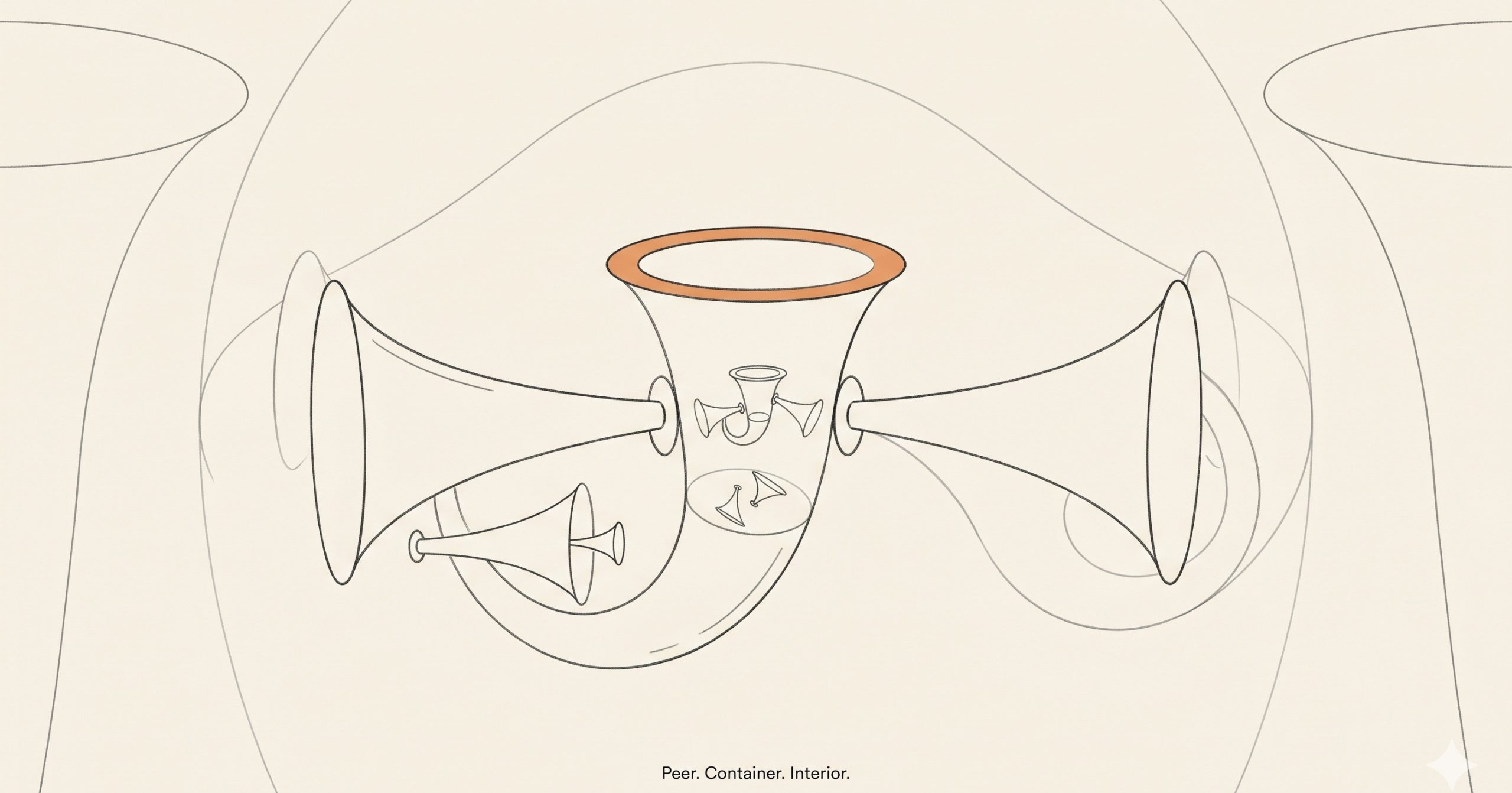
A horn cannot exist in empty space. Every horn stands simultaneously in three directions: peer horns at the same scale (other humans, other blocks at similar chain depth), container horns that enclose it (family, city, planet), and interior horns that compose it (cells, molecules, the trillions of bacterial horns of the microbiome). The universe is a fractal of horns, horns made of horns sitting inside larger horns next to peer horns, horns all the way down and all the way up.
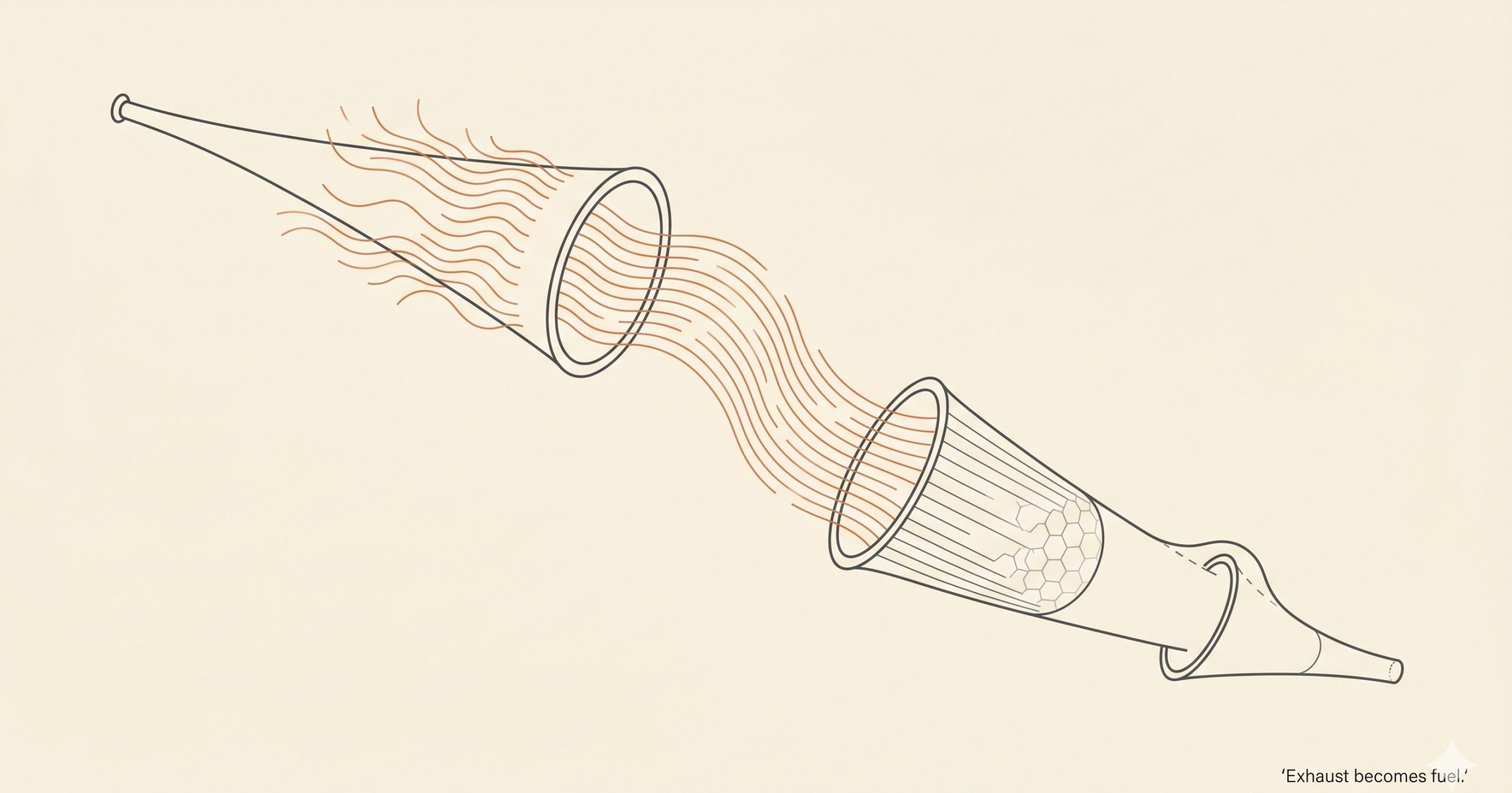
The stability question answers itself once the exhaust principle from Episode 188 is ported into the ecology. Every horn doing interior work vents heat at the Landauer minimum. In an isolated-system picture the exhaust leaks into a void. In a densely packed ecology there is no void. The exhaust from one horn presses into the boundary of the next, which metabolises it as fuel. The sun vents photons; trees build cellulose from those photons; animals eat the trees’ chemical exhaust and vent heat and CO&sub2; back; the food chain is a localised horn ecology. Bitcoin runs it explicitly: block N+1 embeds the cryptographic hash of block N as its foundation, so the waste of the past becomes the unforgeable constraint of the future. Heat death was a theorem about isolated systems, and the universe is not one. The universe is a structure building itself out of the fire.
C is breadth times depth: verifiers pressing on the boundary, multiplied by survived stress cycles. Both factors count surrounding horns. C is not intrinsic. Isolate a horn from its ecology and C collapses to zero; knowledge content collapses with it, regardless of how elegant the interior is. A masterpiece sealed in a safe and sunk to the ocean floor contains high Shannon information and zero knowledge. Newton did not compose the Principia alone in a dark room; he was embedded in the Royal Society, in combative correspondence with Hooke and Leibniz, building on the collected exhaust of his contemporaries. Satoshi wrote the interior in January 2009. The global network wrote the constraint in the seventeen years that followed.
No horn expands forever. When the ratio of boundary to interior diverges past the stability of the tail, the horn pinches. The parent survives, tail truncated. The pinched fragment becomes a child horn, inheriting a compressed fraction of the parent’s constraint and starting its life with a fresh boundary and negligible C. Newtonian mechanics absorbed the precession of Mercury and the ultraviolet catastrophe until its interior could no longer explain the boundary strain, and general relativity pinched off as the child. Scientific revolutions are horn pinches. So are speciations, empires, and paradigms.
The universe itself, on this reading, has to be a horn, and Bitcoin is the second spaceship small enough to walk around and observe from outside. Block zero and the Big Bang share a signature: Shannon entropy zero, internal energy zero, no representation for a block minus one. Constraint and energy were co-created in a single event. Two distinct paths lead to maximum constraint. Brute-force compression, which a black hole exemplifies, yields a sterile child universe whose fundamental constants lack the reach to support complexity. Explanatory compression, which a civilisation of knowledge creators produces by understanding its substrate deeply enough to compress that understanding into a unified theory, yields a child whose constants already permit chemistry and life, because knowledge creators built them. In constructor-theoretic terms, understanding a system completely and writing the next Genesis block are the same physical process. From inside the current universe it looks like discovery. From outside it looks like creation. The framework predicted its own Genesis: it was formalised in a single evening through dense human-LLM exchange, and the theorem, the concept note, and this episode pinched off as three new horns within hours.
Timestamps
- [00:00] Cold open. Horns all the way down, and the impossible bucket of paint
- [02:42] Torricelli, 1641, and the first horn
- [04:58] Bekenstein, Hawking, and the holographic principle
- [06:58] Gabriel’s Horn as universal blueprint
- [07:57] The Bitcoin block as a horn
- [09:08] Newton’s laws and the human mind as horns
- [10:26] K = Ic², the clay and the jug
- [11:31] Why constraint squared: Metcalfe’s law at the boundary
- [13:40] Horn ecology: peer, container, interior
- [16:37] Exhaust becomes fuel
- [19:45] The Bitcoin chain as a linear horn ecology
- [20:31] Heat death inverted, the universe compressing
- [21:49] C as breadth times depth
- [24:29] Newton in the Royal Society, Satoshi and the network
- [27:01] C max and the pinch
- [29:18] Scientific revolutions as horn pinches
- [31:48] Bitcoin as the second spaceship
- [33:41] Two paths to maximum constraint
- [35:32] The framework predicts its own Genesis
- [37:22] The beginning of infinity
- [40:00] Close
Timestamps are estimates.
Topics Discussed
- Torricelli’s 1641 derivation of Gabriel’s Horn: volume converges to π, surface area diverges to infinity
- Bekenstein’s 1973 proof that black-hole entropy scales with event-horizon area, not volume
- Hawking’s failed disproof and the derivation of Hawking radiation
- The holographic principle as the asymmetry’s cosmic consequence
- Bitcoin blocks, Newton’s laws, and the human mind read as horns
- K = Ic² with interior as information and boundary as constraint
- The Metcalfe-law rationale for squaring the constraint term
- The three-direction census: peer horns, container horns, interior horns
- The Exhaust Principle applied to the ecology
- The food chain and the Bitcoin chain as worked horn ecologies
- Heat death as an artefact of the isolated-system assumption
- Constraint quality as ecological census, not intrinsic property
- Scientific revolutions, including Newtonian-to-Einsteinian, as horn pinches
- Bitcoin’s Genesis block and the Big Bang as structurally identical events
- Brute-force versus explanatory paths to maximum constraint
- Constructor theory and the claim that understanding a system is the same physical act as writing its Genesis block
Links & References
- Jacob Bekenstein, “Black Holes and Entropy” (Physical Review D, 1973)
- Stephen Hawking, “Particle Creation by Black Holes” (Communications in Mathematical Physics, 1975)
- Gerard ’t Hooft, “Dimensional Reduction in Quantum Gravity” (arXiv, 1993)
- Leonard Susskind, “The World as a Hologram” (Journal of Mathematical Physics, 1995)
- Rolf Landauer, “Irreversibility and Heat Generation in the Computing Process” (IBM Journal of Research and Development, 1961)
- David Deutsch, Constructor Theory project page
- David Deutsch, The Beginning of Infinity (Penguin, 2011)
- Satoshi Nakamoto, Bitcoin: A Peer-to-Peer Electronic Cash System (2008)
Related Episodes
- Episode #188 – The Exhaust Principle – the direct precursor. Entropy as the receipt for every act of building, and the resolution of the Bekenstein-Hawking puzzle.
- Episode #187 – The Shannon Trap – why Shannon’s 1948 framework measured the wrong quantity for seventy-five years.
- Episode #186 – The Anti-Demon – the first statement of K = Ic² and Bitcoin as the structural inverse of Maxwell’s demon.
Notable Pull Quotes
“The universe is a fractal of horns. Horns made of horns sitting inside larger horns next to peer horns. Horns all the way down, all the way up.”
“Satoshi wrote the interior. The global network wrote the constraint.”
“The universe isn’t some fire that’s slowly burning through its own structure until only ashes remain. The universe is a structure building itself out of the fire. It is actively compressing.”
“From inside the current universe it looks like discovery. From outside it looks like creation.”
“The exhaust from one horn becomes the fuel for another horn.”
Post a comment: