
Episode #188 – The Exhaust Principle
In 1973, Jacob Bekenstein, then John Wheeler’s graduate student at Princeton, demonstrated that a black hole’s entropy is proportional to its surface area, a formula that Stephen Hawking and Brandon Carter would later confirm despite setting out to disprove it. The result has been treated as a paradox for fifty years. This episode argues that the paradox dissolves when the second law is read correctly, and the framework that emerges is the Exhaust Principle: entropy is the receipt for every act of building since Genesis, and the black hole is the biggest engine physics permits.
Episode Summary
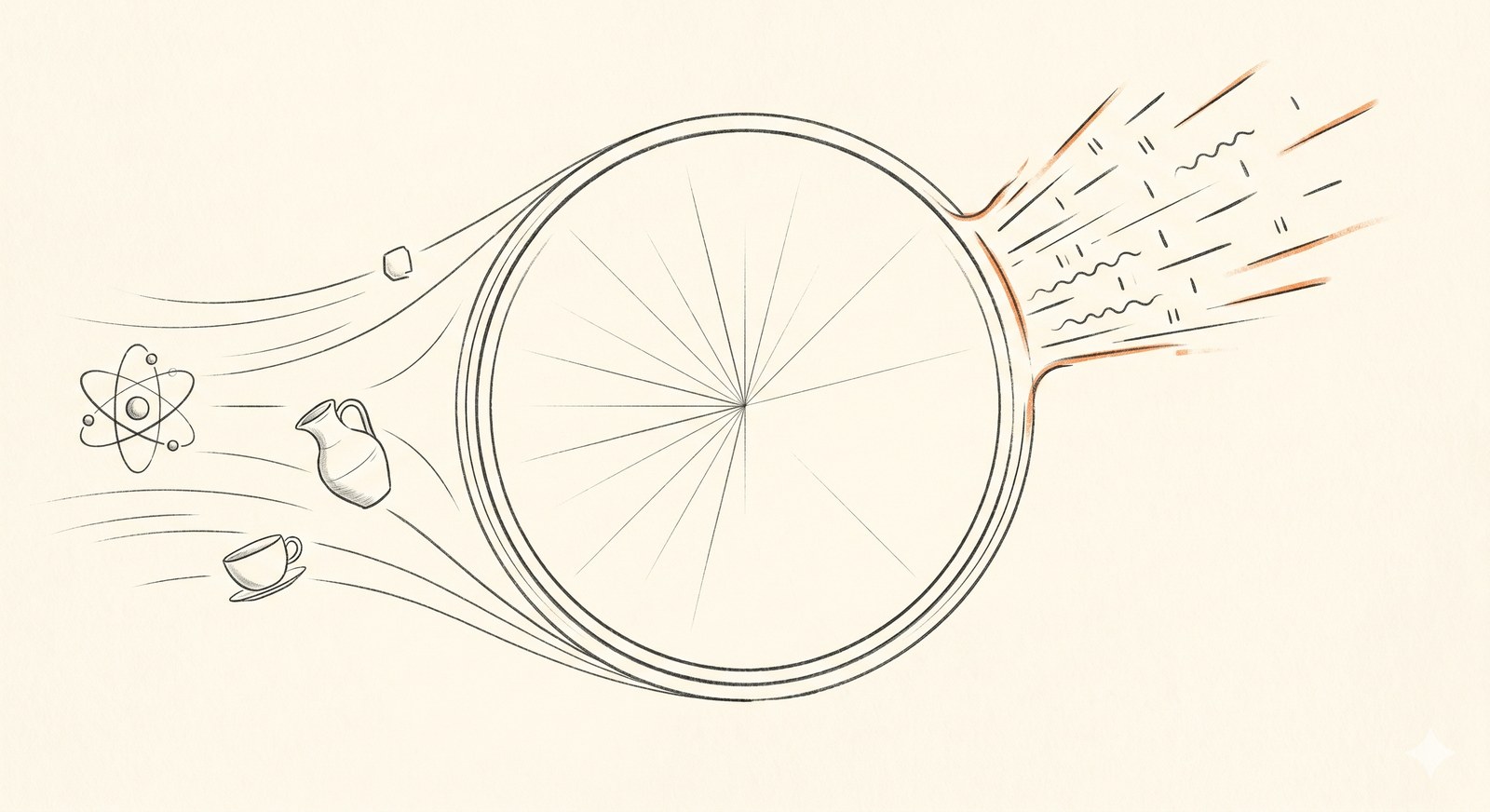
John Wheeler, in a filmed interview discussing his work on A Journey into Gravity and Spacetime, once told a story about a conversation with his graduate student Jacob Bekenstein. Wheeler had been thinking about the second law of thermodynamics. He remarked that if he placed a hot tea cup next to a cold tea cup, the two would come to a common temperature, and the universe’s entropy would have gone up because of him. The second law made him complicit. He proposed a solution to his student: if he dropped both cups into a black hole, he could conceal the evidence of the crime. The entropy would leave the universe. The second law would have been outrun. Bekenstein returned some months later with the correction that now carries his name. The entropy had not been outrun. It had been moved. A black hole’s surface area, Bekenstein showed in 1973, encodes an entropy proportional to its area. Stephen Hawking and Brandon Carter, reading the paper and finding it implausible, set out to disprove it. The work they produced instead confirmed Bekenstein’s result, fixed the missing numerical constant, and led Hawking to the radiation that now carries his name.
The result has sat in physics textbooks for fifty years as a puzzle. A black hole is the most compressed object in the universe. A stellar-mass black hole carries approximately 10^77 bits of entropy, more than every star in the observable universe combined. If entropy is disorder, then the most compressed thing in the universe has the most disorder, which makes no physical sense. The standard response has been to note that entropy counts microstates rather than disorder, which is mathematically correct and physically unsatisfying. The artist who illustrated Wheeler’s book covered the black hole’s surface with small boxes, and a friend flipped coins to decide which boxes were black and which were white, so that the resulting picture showed the black hole’s entropy as a surface of random dots. That image has served as the textbook visualisation of Bekenstein-Hawking entropy for half a century.
This episode proposes that the paradox dissolves the moment the second law is read correctly. The second law describes the heat produced when the universe builds. Every act of constraint creation pays energy as heat at the Landauer exchange rate. A star fusing hydrogen into helium pays energy against strong-force repulsion and produces heat as the receipt. Living cells maintain chemistry against diffusion at metabolic cost, and body heat is what that cost looks like from outside. A Bitcoin miner securing a block burns megawatts of electricity that leave the facility as radiated heat. Each act of building produces exhaust, and the exhaust is what the second law measures. Call this the Exhaust Principle. Entropy is the receipt for every act of building since Genesis.
Read in this frame, the black hole stops being a paradox and becomes the prediction. A black hole reaches the absolute maximum constraint physics permits by crushing every degree of freedom in the infalling matter to its limit. Maximum constraint creation produces maximum exhaust. The Bekenstein-Hawking entropy is what one would expect from the universe’s largest engine running at full load. Hawking radiation is the same engine’s exhaust pipe, radiating constraint away at the Landauer minimum one bit at a time. Wheeler’s artist, drawing random dots to depict disorder, was drawing the receipt for the universe’s largest act of building. Every dot on that surface is a fully specified bit, maximally constrained. What looks random from outside the engine is fully determined inside it.
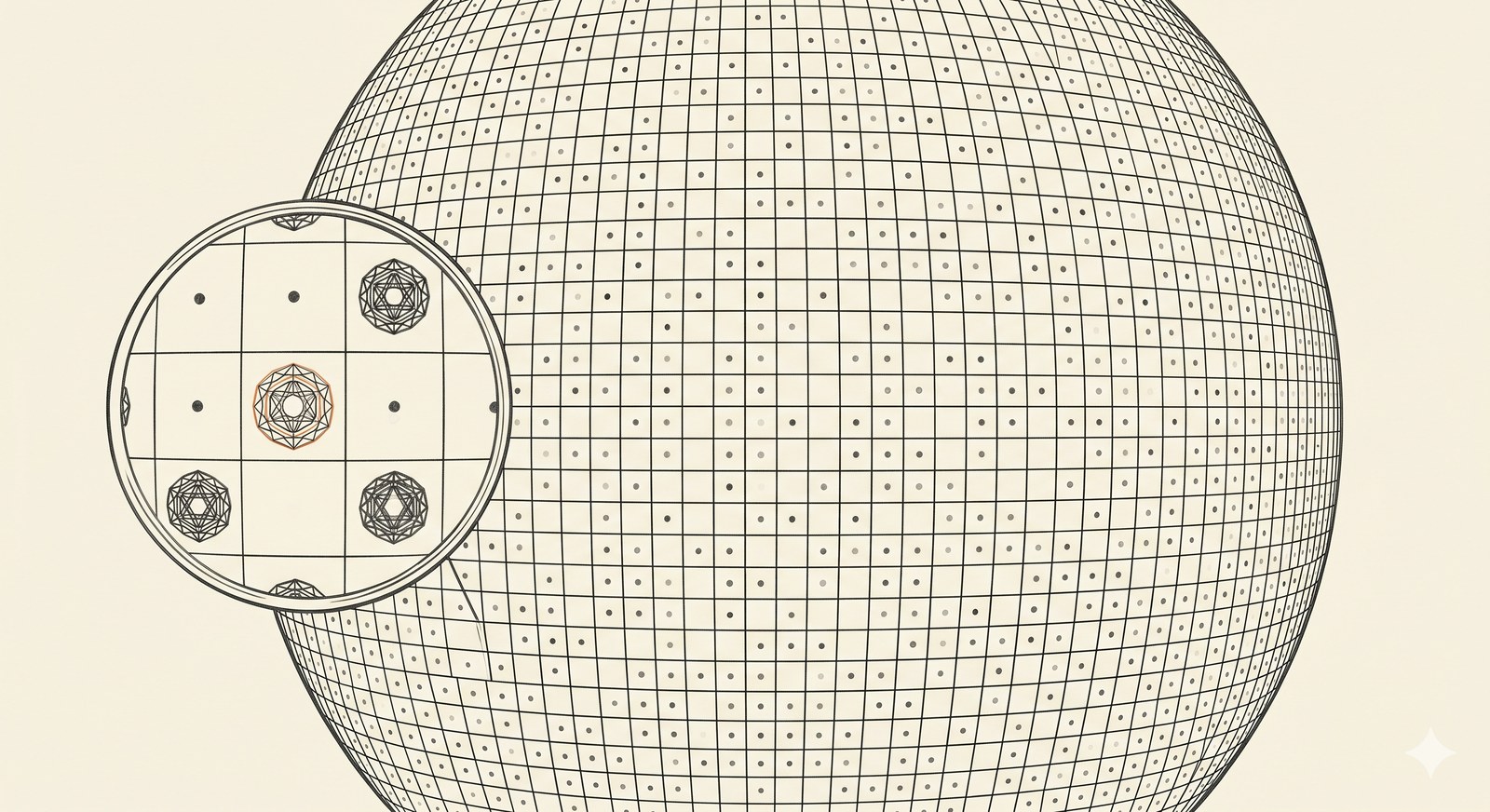
The principle forces a distinction between two paths to maximum constraint. A black hole reaches it by brute compression. The constraint is real, and every degree of freedom is specified, but the reach is zero. It does not explain anything. It is the cosmic equivalent of a random-key-press sequence that happens to produce exactly 285 bytes. A knowledge creator reaches maximum constraint through understanding. The constraint is also real, but the reach is unbounded. Newton’s mechanics reached from falling apples to planetary orbits and later to spaceflight. Einstein’s equations hold from Mercury’s perihelion through the gravitational waves LIGO detected in 2015. Bitcoin’s ledger has reached from a pseudonymous whitepaper into trillions of dollars of value across every continent. Both paths produce maximum exhaust. Only one produces a Genesis block whose initial conditions support further complexity. Brute-force Genesis probably produces sterile daughter universes, with constants that do not permit atoms or chemistry. Explanatory Genesis produces a universe whose constants permit complexity because complexity is what generated those constants in the first place.
The structural identity between Bitcoin’s Genesis block and the Big Bang stops being a metaphor under this reading. Both have Shannon entropy of zero at the Genesis moment: one possible output, a fully specified initial state. Both have zero net internal energy at the start: Bitcoin’s Genesis coinbase is unspendable, and the Big Bang’s mass-energy nets to zero if gravitational potential balances the positive mass-energy, as Edward Tryon proposed in 1973 and Alan Guth developed in 1997. Neither has a “before.” The system has no representation for block minus one or for pre-Big-Bang time. In both cases, the rule-set becoming operative is simultaneously the creation of the energy-constraint pair that the rule-set accounts for. The constraint creates the value. The Genesis block does not need funding because it funds itself by existing.
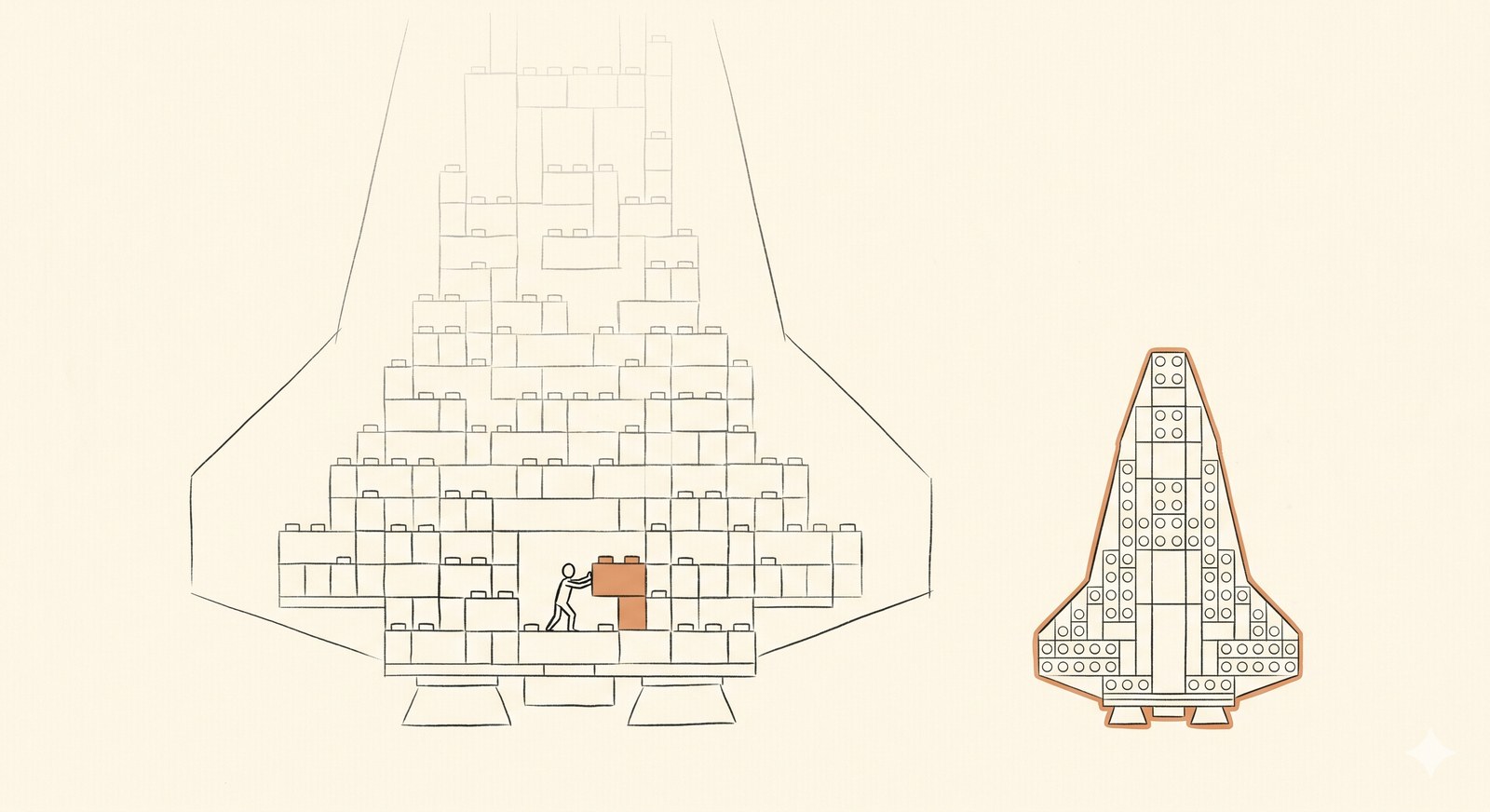
The instrument that made the entire line of reasoning thinkable is Bitcoin block time. Until 2009, there was no instance of a bounded totality whose internal activity kept growing under fixed rules that could be observed from outside. The universe is a bounded totality with unbounded internal activity, but its inhabitants cannot step outside it to watch. A physicist working inside the universe is a small LEGO piece inside a large spaceship, able to push the piece next to it and see what moves, able to map connections one at a time, never able to see the whole ship. Every experiment is a push. The reach of the push is the reach of the explanation. Bitcoin is a second spaceship, small enough to walk around and observe from every angle, and the second spaceship is what taught us how to look at the first. The Exhaust Principle, the two paths to Genesis, the Bekenstein-Hawking resolution: each of these conjectures was unreachable from inside-only observation. Bitcoin is the Rosetta stone.
Bitcoin’s constraints came from Satoshi, a knowledge creator who understood the inherited constraints of monetary history, cryptography, and computer science deeply enough to compress that understanding into a rule-set and deploy it. The universe’s constraints came from the same structural process one level up, from knowledge creators in a prior cycle who understood their substrate deeply enough to compress the understanding into the initial conditions of our universe. The question “what came before the Big Bang” is syntactically valid and has no referent, in the same way “what is at block minus one” has no referent within Bitcoin. The recursion does not require a mystical first cause. It requires only the observation, which Satoshi’s existence confirms, that knowledge creators inside a bounded totality can compress their understanding into the Genesis event of a new one.
Here the argument takes its deepest turn. Understanding a system completely is the same act as fully specifying that system, and a complete specification of a self-consistent system IS that system. It is the principle of a perfect emulator: a complete specification of a computer’s transistors and circuits runs as that computer, not as an emulation of it. The understanding is already physical. Satoshi’s understanding of the financial system was a physical arrangement of neurons in his brain, maintained at metabolic cost. Mining block zero was the copying of that constraint from one physical substrate to another. By the framework’s logic, the next universe’s Genesis block is already under construction, in the brains of physicists, in the paper records of their results, and in the computers running AI systems that are accelerating the reading. The process is continuous. The Genesis event is the threshold at which the accumulating physical arrangement of understanding becomes complete enough to run as a self-consistent system. We are not living in the remembering. We are living in the building.
Timestamps
- [00:00] Jack’s response and the tunnel metaphor
- [01:00] The LEGO spaceship: physics is pushing pieces from inside
- [02:49] If the spaceship is being built and the heat is exhaust
- [03:16] Recap of Episode 187 and the correction
- [04:11] The universe is not relaxing. It is compressing.
- [05:31] The Exhaust Principle stated
- [07:14] The second law as the receipt for building
- [07:26] Why both axes rise: constraint and entropy coupled
- [09:05] Wheeler’s tea cups and Bekenstein’s 1973 correction
- [10:10] Hawking and Carter try to disprove, prove Bekenstein right
- [10:41] The artist, the coin flips, and the surface of random dots
- [11:20] The resolution: biggest engine, biggest exhaust pipe
- [12:28] Hawking radiation as the exhaust pipe
- [12:55] The four engines running in Wheeler’s story
- [13:46] Two paths to maximum constraint
- [16:00] Big Bang as Genesis block
- [17:16] Energy and constraint co-created from zero
- [19:01] Bitcoin block time as the unlock
- [20:24] Bitcoin as the Rosetta stone
- [21:00] Where constraints come from
- [23:14] Reading the code all the way down IS writing the next block
- [23:37] Shannon measured the clay, we measure the jug
- [26:21] The perfect emulator
- [28:12] The Genesis block is already physical
- [30:00] Close: we are living in the building
Timestamps are approximate.
Topics Discussed
- The correction to the Episode 187 framing: the universe is compressing, not relaxing
- The Exhaust Principle: entropy is the receipt for every act of building since Genesis
- Why both axes rise at once: constraint and entropy are engine and exhaust, not opposites
- John Wheeler’s tea cups thought experiment and Bekenstein’s 1973 correction
- The Bekenstein-Hawking area law and the discovery of Hawking radiation
- The Exhaust Principle’s resolution of the black hole entropy puzzle: biggest engine, biggest exhaust pipe
- Two paths to maximum constraint: brute force versus explanatory understanding
- Why brute-force Genesis probably produces sterile daughter universes
- The structural identity between Bitcoin’s Genesis block and the Big Bang
- Tryon’s 1973 zero-energy universe hypothesis and Guth’s 1997 development
- Bitcoin block time as the first observable bounded totality with unbounded internal activity
- Where constraints come from: knowledge creators at the level above
- The perfect emulator argument: understanding a system completely is specifying it
- Why the Genesis of the next universe is already under physical construction
Links & References
- Jacob Bekenstein, “Black Holes and Entropy,” Physical Review D, 1973
- Stephen Hawking, “Particle Creation by Black Holes,” Communications in Mathematical Physics, 1975
- Rolf Landauer, “Irreversibility and Heat Generation in the Computing Process,” IBM Journal of Research and Development, 1961
- Antoine Bérut et al., “Experimental verification of Landauer’s principle,” Nature 483, 2012
- Edward Tryon, “Is the Universe a Vacuum Fluctuation?” Nature 246, 1973
- Alan Guth, The Inflationary Universe (Perseus, 1997)
- John Wheeler, A Journey into Gravity and Spacetime (Scientific American Library, 1990)
- Satoshi Nakamoto, “Bitcoin: A Peer-to-Peer Electronic Cash System” — bitcoin.org/bitcoin.pdf
Related Episodes
Notable Pull Quotes
“The universe is not relaxing. The universe is compressing.”
“Entropy isn’t the trend. It is the receipt that you get for building.”
“The second law isn’t the universe running down. It’s the exhaust from the universe building up.”
“The artist drew the receipt when they thought they were drawing the disorder.”
“Wheeler and Bekenstein were measuring the exhaust pipe. They thought they were measuring disorder. Same numbers. Wrong object.”
“Reading the code all the way down is writing the next block. Understanding and creation are the same act.”
“The Genesis block was always in Satoshi’s head. Mining block zero just gave it its own chain to run on.”
“We are not living in the remembering. We are living in the building.”
Post a comment: