
Episode #191 – Why The Search Has To Be Expensive
P versus NP is the question of whether finding a solution is genuinely harder than checking one. Almost every working mathematician believes finding is harder, and the entirety of modern digital security assumes they’re right. The same asymmetry runs through Einstein deriving E equals MC squared and through a Bitcoin miner burning gigawatts to find one valid nonce.
Episode Summary
P versus NP asks whether two families of problems are secretly the same. The first family includes a thousand-piece jigsaw, the verification of a Bitcoin block, and the check on Einstein’s E equals MC squared. Finding the solution is expensive. Checking it is cheap. The second family includes sorting a list of names or multiplying large numbers, where finding and checking take comparable effort. Computer scientists call the hard-to-find family NP and the easy-to-find family P. The unsettled question is whether NP secretly collapses into P once you’re clever enough. Every working cryptographer hopes it doesn’t. Nobody has proved either side in fifty-five years.
If P turned out to equal NP, digital civilization would come apart in days. Public-key cryptography would collapse, which means HTTPS, banking signatures, password managers, and end-to-end messaging all become trivially breakable. Bitcoin mining would stop being a search problem and a single laptop could rewrite the chain in real time. The mathematical floor under everything we trust online assumes the asymmetry holds. So far, it has.
The interesting move is to notice the same asymmetry running through human cognition. Einstein in the patent office, working on the inconsistency between Maxwell’s equations and Newtonian mechanics, was running an NP search. His skull was a container with finite contents and an unbounded interaction surface: twenty-six years of life, the formal training in physics, every patent he had read on clock synchronization. The candidate space of mathematical relationships was effectively infinite. What made his search tractable was the quality of constraints already inside it. He knew the answer had to be a Lorentz invariant and to reduce to Newtonian mechanics at low velocities. It also had to conserve energy and produce testable predictions. Those constraints turned an astronomical search space into a tractable one. A random person without them would have searched forever.
The moment Einstein finds the equation, the pawl catches in his brain. He pays the energy of the search in months of metabolic effort, and the pattern that encodes E equals MC squared lays down irreversibly. That’s one tick of internal time generated in one head. Then the horn branches. He writes the paper, copying the pattern from neurons to ink at the cost of some compression. Planck reads it, verifies the math in hours rather than years, and approves it for publication. The journal copies the horn again, distributing it to thousands of subscribers. Each verification is another tick of the pawl catching in another brain. The original search was expensive. Every subsequent verification was cheap. Constraint climbed from one to hundreds to millions. The same fractal structure runs through Darwin’s five-year voyage and his decades of correspondence, through every act of knowledge generation in human history, and inside the firing pattern of every neuron.
Bitcoin is the cleanest engineered case of this engine humans have ever built. A miner draws megawatts off the grid and burns them across hundreds of thousands of specialised chips, each guessing numbers for ten minutes on average and generating an enormous count of guesses before one of them lands on a hash with the right run of leading zeros. The winning guess broadcasts. Every full node verifies it in milliseconds. A laptop in someone’s closet checks what an industrial city block of electricity produced. The substrate is silicon rather than neurons, but the principle is identical: search cost large, verification cost small, asymmetry the engine. Einstein took years and got one equation. Bitcoin takes ten minutes and gets one block.
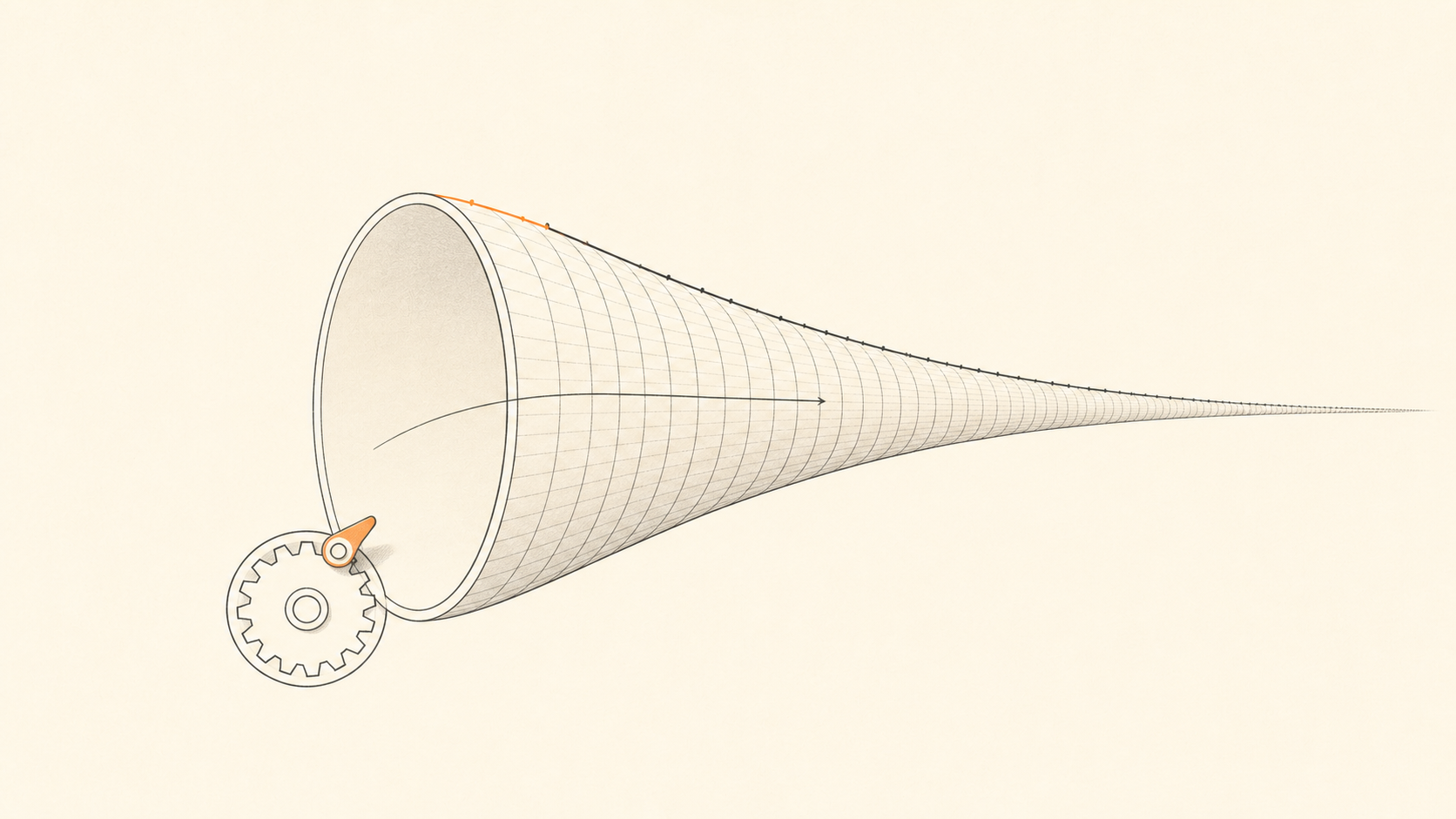
Gabriel’s horn draws the cost asymmetry as geometry. The interior is the verifier, finite and easy to fill with paint. The boundary is the search space, unbounded. Discovery traverses the surface. Verification measures the volume. That topology is what knowledge has to take inside any container where finding stays harder than checking. Evangelista Torricelli, sketching the horn in 1641, was drawing the underlying shape of digital security three centuries before anyone built one.
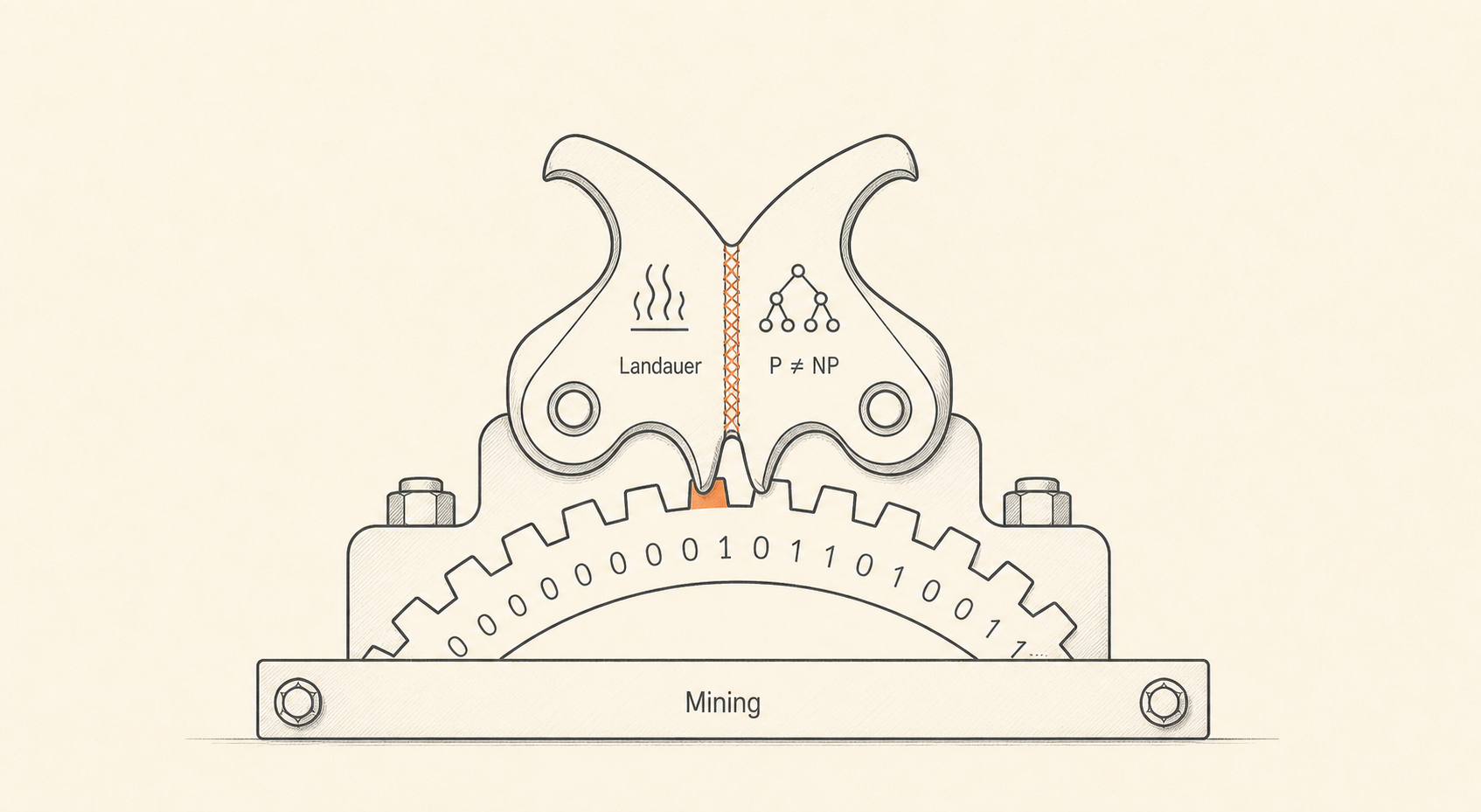
Bitcoin’s contribution is that it builds the horn on purpose, using two distinct pawls welded together. The first pawl is thermodynamic: Landauer’s 1961 result that erasing a bit of information has an unavoidable energy cost. The second is computational: the conjecture that P does not equal NP. One is settled physics. The other is a fifty-five-year-old open problem. Mining bolts them into a single mechanism. The energy dissipated is forced by Landauer. The hash difficulty is forced by the cryptographic conjecture. To produce a block, a miner has to pay the thermodynamic cost of computing hashes, and the computation itself has to traverse the surface of the horn because no shortcut exists.
The simplest way to feel why this matters is to picture cyberspace as a giant pile of wet clay. Bits can take any shape. Any pattern can be made to look like any other. Anyone with admin rights can rewrite the deed to your house and copy it a million times, and no force in the system makes one of the copies the real one. Bitcoin is a kiln inside that clay pile. Mining is the firing. Energy commits upfront. The transformation is irreversible. The verdict comes from an external reference the miner can’t control, which is the network of nodes. The kiln only stays hot because finding the right hash is hard, and the hardness is the conjecture that P does not equal NP. If that conjecture fell, the kiln would cool. The clay would stop baking. Cyberspace would slip back to being a place where disputes can’t be settled, only deferred until someone drags them back into physical reality, where commitments stick.
Time itself only exists where the asymmetry holds. From outside any container, with oracle access to every configuration, P trivially equals NP. There is no search and no flow. From inside, configurations have to be searched for at real cost. The accumulation of those costs across the container’s history is what we have always called time. A universe that began small enough to have no internal search space had no time either. As the container expanded and constraints emerged, the asymmetry opened, and the engine started. Bitcoin runs the same engine in silicon, publicly and observably, every ten minutes since 2009. The connection between the universe’s clock and Bitcoin’s clock is mechanism, all the way down.
Timestamps
- [00:00] Have you ever heard of P versus NP
- [01:20] Why finding is harder than checking, and what that has to do with time
- [04:22] The thousand-piece jigsaw, the Bitcoin block, the same asymmetry
- [05:50] NP defined: hard to find, cheap to check
- [06:38] The unsettled question, is NP secretly P
- [07:27] What collapses if P equals NP
- [09:07] Einstein in the patent office as an NP search
- [12:48] C squared as search-pruning power
- [14:21] The horn branches: brain to paper to community
- [16:34] Planck verifies in hours what Einstein took years to find
- [19:23] Why P does not equal NP has to hold at every level of the recursion
- [20:30] Bitcoin as the engineered instance running publicly
- [23:08] Gabriel’s horn as the geometric form of the cost asymmetry
- [23:48] Torricelli, 1641, drew the topology of digital security
- [26:27] The two pawls: Landauer and the P versus NP conjecture
- [29:02] Mining as the welding of physical and mathematical asymmetry
- [30:13] Why time itself requires the asymmetry to hold
- [31:33] The clay, the kiln, and what cyberspace was before Bitcoin
- [33:51] The horn versus the cloud
- [36:07] Why irreversibility in cyberspace matters: dispute settlement
- [39:23] The horn as the universe’s attractor
- [40:42] Next episode: evolution as selection for horn geometry
Timestamps are approximate.
Topics Discussed
- P versus NP defined: the asymmetry between finding and checking
- The fifty-five-year-old conjecture that P does not equal NP
- What breaks if the conjecture fails: HTTPS, banking signatures, password managers, Bitcoin
- Einstein in the patent office as an NP search through neural configuration space
- C squared as search-pruning power, not only verification quality
- How knowledge copies from brain to paper to community at the cost of some compression
- The cost asymmetry running fractally from neurons to scientific institutions
- Bitcoin as the cleanest engineered case of an NP-asymmetric container
- Gabriel’s horn as the geometric form of the cost asymmetry
- The two pawls: Landauer’s thermodynamic floor and the P versus NP conjecture
- Why cyberspace was clay before Bitcoin and a kiln after
- Why time itself requires the asymmetry to hold inside the container
- Lowery’s softwar thesis read through the framework: power projection plus time generation
Links & References
- Stephen Cook, “The Complexity of Theorem-Proving Procedures,” Proceedings of the Third Annual ACM Symposium on Theory of Computing, 1971
- Leonid Levin, “Universal Search Problems,” Problems of Information Transmission, 1973
- Clay Mathematics Institute, P versus NP Problem — claymath.org/millennium-problems/p-vs-np-problem
- Rolf Landauer, “Irreversibility and Heat Generation in the Computing Process,” IBM Journal of Research and Development, 1961
- Albert Einstein, “Zur Elektrodynamik bewegter Körper,” Annalen der Physik, 1905
- Charles Darwin, On the Origin of Species (1859)
- Evangelista Torricelli, De solido hyperbolico acuto (1641)
- Jason Lowery, Softwar: A Novel Theory on Power Projection and the National Strategic Significance of Bitcoin (US Naval Postgraduate School thesis, 2023)
- Satoshi Nakamoto, “Bitcoin: A Peer-to-Peer Electronic Cash System” — bitcoin.org/bitcoin.pdf
Related Episodes
- Episode 190 – What Time Is
- Episode 189 – The Geometry of Gabriel’s Horn
- Episode 188 – The Exhaust Principle
- Episode 187 – The Shannon Trap
Notable Pull Quotes
“The horn, it’s not a metaphor for NP. The horn is the geometric picture of the cost asymmetry that NP names in mathematics.”
“Bitcoin is a kiln inside of cyberspace.”
“P does not equal NP is what keeps the kiln hot inside the container.”
“Mining isn’t just computation. It’s not just an energy expenditure. It’s the welding together of two distinct asymmetries. One physical, one mathematical, into a single security mechanism.”
“The unification isn’t a metaphor. The unification is the mechanism. And the mechanism is the cost asymmetry of NP.”
Post a comment: